
How to Create a Marketing Plan for Your Small Business
Written by Jessica Freeman, Web Designer and SEO Strategist since 2011 • Post Last Updated September 2026
Marketing your small business stops feeling like guesswork when you plan around your own goals instead of someone else’s strategy, and owners with a documented marketing plan are 3x as likely to say their marketing is working. To create a small business marketing plan that matters, set 1–3 goals, choose channels based on where your ideal customers spend time, list the tasks that move you toward those goals within your available capacity, and track 6–12 KPIs to see what’s actually working.
You’ve been in business for more than a hot sec. Like, at least long enough to have experience the messy soup of emotions that comes along with doing your own marketing. The moments where you’re absolutely stoked. The ones that feel defeating. And all the times you’ve probably asked yourself “what in the hell is actually going on right now?!?”
Me? I’ve been living in the same world but looking at all this from a different perspective than you. Because for the past eleven years, I’ve been thinking about and trying to solve the “I do my own marketing” problem. But not because I personally have an issue with getting it done (not a brag, just the reality). But because 93 out of 100 business owners I talk to are in the thick of that messy soup.
Collecting ideas they’re excited about but never using any of them.
Starting a new marketing thing and not finishing it.
Feeling like they are on the worst emotional roller coaster because their business has to work. There is not another option.
So after talking to Jess about a lot of this in this episode of The Ordinary Business podcast, I wanted to go deeper on a specific part of the conversation. The whole “what matters” part. Because it’s obviously important, but the answer is different for everyone (despite all the steal-my-strategy content you’re getting served on Instagram).
Two Things That Matter When Marketing Your Small Business
I know you’ve followed someone, opted into a freebie, or bought a course at some point because it felt like that person had their marketing sh*t super together. And, hey—if it works for them, it should work for me…no?
No.
Maybe that was harsh. At least, it’s extremely unlikely. Because that person’s business is not the same as yours. It has different goals, a different brand, person behind it, audience…shall I go on? And even though someone could have landed on a mix of marketing tactics and messaging that works really well for them, that does not mean it’s going to work well for you.
So when it comes down to figuring out what matters (and will be worth it for you) in regards to marketing your small business, what you decide to do (and not do) should be built around your goals and your capacity.
But the internet is fantastic at peer pressuring us into things. Which is why (keep reading).
You Feel Like You “Don’t Even Know What to Do” for Marketing
Figuring out what marketing to do feels pretty overwhelming for a lot of small business owners—even the ones who like doing marketing. And the reason making those decisions for yourself is way more challenging than it should be is because you’ve put yourself in this black box.
Because you can’t really see the marketing machine you’ve built. And you have no proof if anything is working.
How to Create a Marketing Plan Around What Matters for Your Small Business
So if you’ve gotten this far and are [insert emotion] about making sure you’re marketing your business in a way that matters, let’s dig into that. And we have to do a quick call back to those two things first: your goals and capacity.
Because before you get any further, you need to use those things as lines you won’t cross. Because you are feeling all the feels right now because you have crossed those lines. Trying to make marketing work that doesn’t matter for your goals. And at a pace that is not in alignment with the reality of how much time you have.
Cross those lines at any point in time and you will become the melty face emoji.
Okay, so when it comes to creating your marketing plan, here is how I guide people towards doing that:
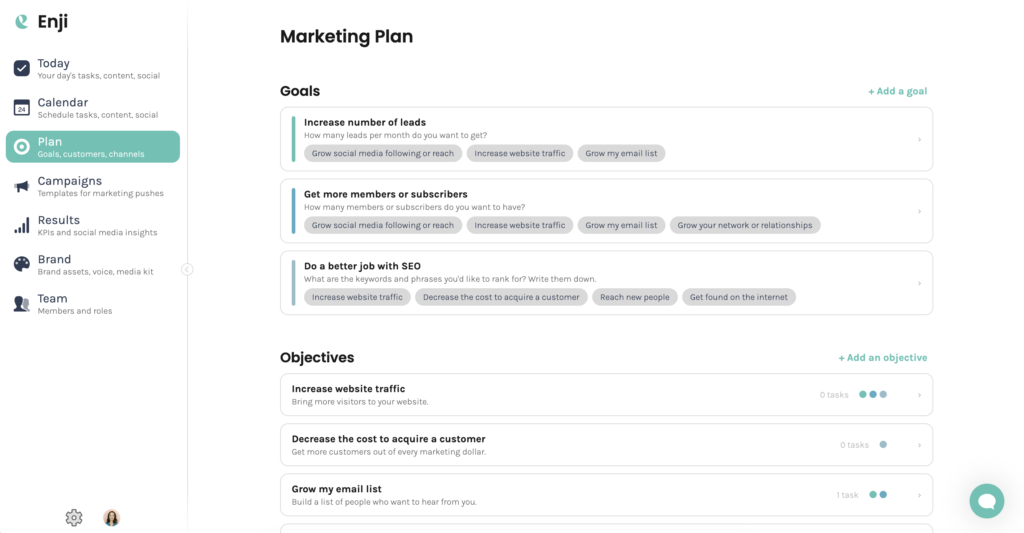
- Write down 1-3 goals you have
- Create of revisit your ideal customer personas. Where are those people hanging out? Use that to decide on your marketing channels
- Think about the tasks you can do in order to reach those goals (this is different from specific ideas for things like reels so don’t overthink it!)
That’s it. It’s not complicated if you don’t overcomplicate it. And if you know that’s what you usually do, you can let Enji create your marketing plan for you. (We created our own AI so my brain could be the thing powering that magic.)
This is super important because in order to know in the future whether or not your marketing is working, you’ve got to have documentation of what in the hell you actually did! And, according to Enji’s State of Small Biz report, small business owners with a documented marketing plan are 3x as likely to say their marketing is working. Sooooo, yeah.
Is Your Marketing Working?
This, my friend, is where you have no other choice but to start tracking your results. Because even though you definitely feel certain things about your marketing, sometimes our emotions do us dirty. Telling us things were worse or better than they actually were.
So knowing whether your marketing is working is a mix of being able to track progress and knowing it you actually hit targets. Because some of your goals might be more long term (like getting better quality leads) and others might be things you can hit shorter term targets around (like doing a better job with SEO).
And when it comes to tracking your results, I’m not talking about all the numbers. Oftentimes more numbers makes things more confusing. But, for example, if your goal is to do a better job with SEO, you could track things like:
- Your monthly website traffic
- The percentage of traffic that is organic
- Your most visited website pages
That mix of things would help you understand if the effort you’re putting into SEO is helping you get more organic traffic, if the number of people visiting your website is ticking up, and which blog posts, pages of your website, etc. are doing the most work for you.
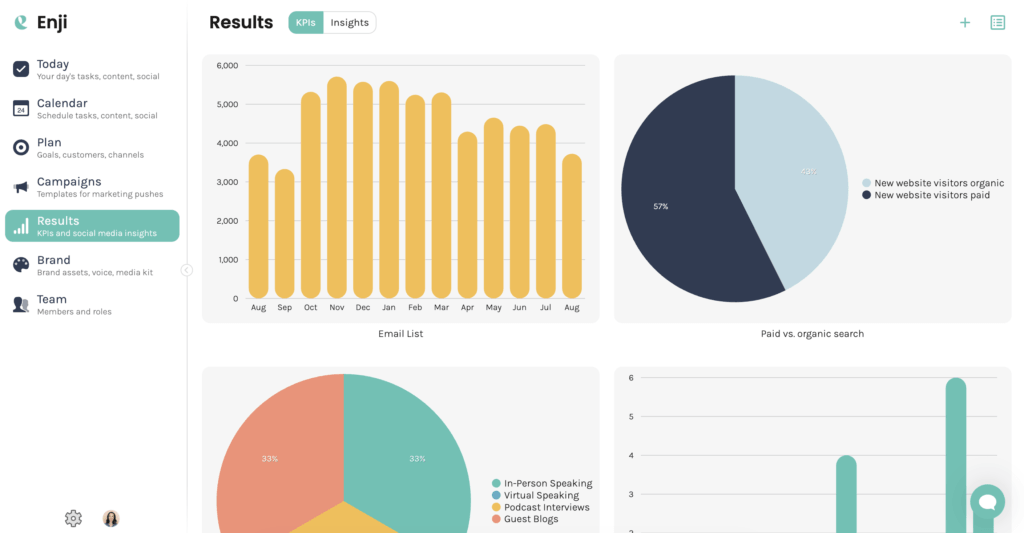
In the end, you likely will end up with 6-12 KPIs (key performance indicators) that help you see whether your marketing plan is working. And you can track those in a spreadsheet or have Enji automatically track your numbers and turn those numbers into easy-to-read charts.
And psssst. Small business owners who track their KPIs and use the numbers to make decisions are 2.8x as likely to say their marketing is working!
How You Are Currently Doing Your Marketing vs. Doing it With Enji
I’ve already mentioned two ways Enji can help you do the marketing that matter, but I wanted to make sure to give you a clear picture. Especially since you’ve gotten this far!
Enji makes sure you’re not just thinking about doing your marketing but that you’re actually getting it done. And it can make that happen because it actually helps you do your marketing plan!
Instead of not having a marketing plan (or one in a Google doc you never look at), you have your marketing plan in Enji that guides you towards doing the things that matter for your goals.
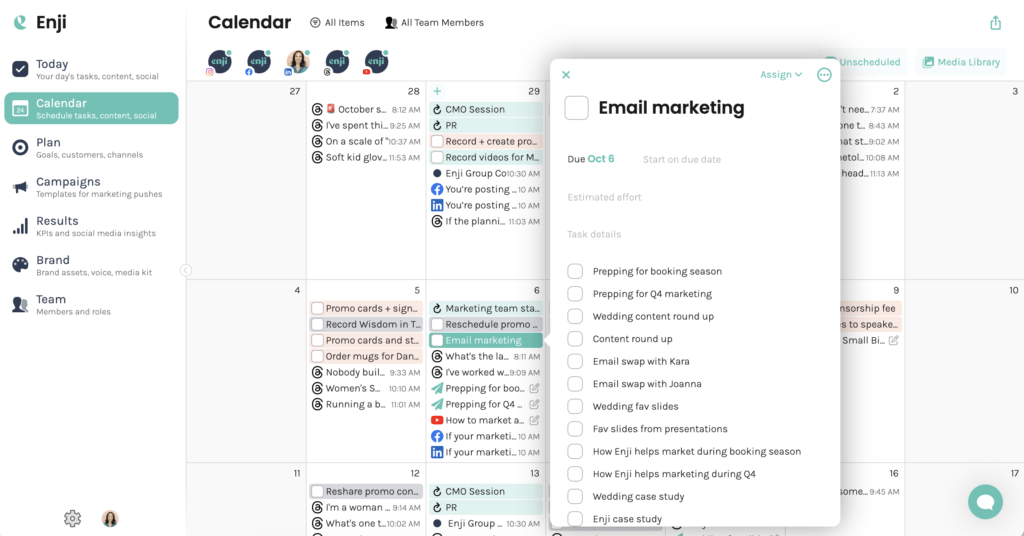
You can see everything about your marketing on your marketing calendar where you can project manage yourself, use the AI copywriter to draft content, and schedule social media posts with the scheduler.
Then to create a feedback loop for yourself that helps you make your marketing plan more and more focused on what works over time, Enji tracks your results for you—helping you make educated decisions about what to keep doing and what to cut.
You can try Enji free for 14 days to really see what it’s like to have your marketing organized in a tool that gets what you’re trying to do. And if you want to upgrade, use the code ORDINARY to save 50% on your first 6 months of Enji! (Two group coaching calls every month with me and guest experts are included!)
This article is written by my friend, Tayler Cusick Hollman. Tayler is a marketing consultant turned small business champion and the founder of Enji, a marketing project management tool designed to help small business owners stop just thinking about doing your marketing and actually get it done. After more than a decade working alongside small business owners, Tayler recognized a common challenge: it wasn’t just knowing what to do—it was getting marketing done consistently. She built Enji to solve that problem. And by being one place you can plan and do your marketing, Enji helps small business owners turn ideas into finished tasks that make them money.
