
What Your Private Practice About Page Should Actually Say
Written by Jessica Freeman, Web Designer and SEO Strategist since 2011 • Post Last Updated October 2026
A private practice About page works when a nervous stranger can tell, within the first screen, who you help and what happens if they book. Most of the ones I see (incorrectly) use that page as a resume.
I’ve worked with more than 450 health and wellness practitioners at Jess Creatives, and when a client sends me their site for the first time, the About page almost always does one of two things. It starts somewhere around second grade (a formative moment, a family member’s illness, a calling that arrived early) and spends so long on the origin story that nothing is left about what they do or who they help. Or it goes the other way: two paragraphs, a credential list, and a contact link in the footer. Neither of these are great!
The person reading is not scanning for your degrees, they are deciding whether they can tell a stranger about their marriage, their back pain, or the other symptoms and issues they’re dealing with. They want to see a face, get a sense of how you talk, and find out what happens on the first call.
Nielsen Norman Group’s usability research on corporate websites found that people check About pages for quick answers to basic questions about who you are, and that first impressions form fast and color how they judge the rest of the site (Loranger, 2015). Corporate sites are not private practices, but the same situation applies: a potential client or a referral partner is forming an opinion in seconds, and that opinion decides whether they reach out or move on to someone else.
Why is your About page so hard to write?
Your About page is hard to write because your clinical training taught you to center the client and listen more than you speak, and an About page asks you to step forward and make a case for why someone should trust you. Nobody teaches that in grad school either, so the page gets written in a rush or copied loosely from a colleague’s site, then sits untouched for three years while your practice changes around it.
The other trap is the credential list. Credentials matter, but they rarely decide who someone books. People want to know you’re good at what you do, and they want to know whether they’ll feel okay in the room with you. Clinicians have told me their inquiries picked up after a rewrite that sounded more like them (same credentials, different tone), though I don’t have numbers to show you.
The page has to carry both jobs at once, and that is the whole difficulty.
What are people looking for on an About page?
People reading a private practice About page want three things: proof that you understand their problem, a sense of whether they could talk to you, and confirmation that you’re qualified. They aren’t reading it like a résumé. They’re asking whether this person gets what they’re dealing with, whether they could sit across from her, and whether she’s the real thing.
That order matters. Open the page with what the reader is dealing with, then bring yourself in as the person who can help. If the first thing they read is about you, they have to guess whether the page is for them, and some of them will guess no and leave.
Warmth counts in the research too. A 2021 study of chronic patients in the journal Healthcare found that a physician’s warmth had a slightly stronger effect than their competence on how useful and easy to use patients judged physician-centered online health communities, which in turn shaped whether they intended to use them (Zhang and Zhang, 2021). The study looked at online health communities, so treat it as a hint about what patients value, with no direct measurement of About pages in it.
Clients bring questions like “Will you judge me?” and “Have you actually worked with people like me?” to a first session, and many of those can be answered on your page before anyone books. That is ordinary good communication.
Search engines and AI tools also build their picture of you partly from your own site, so a page that says plainly who you are and who you serve gives them something clear to quote. Clarity is good writing and good search strategy at the same time.
What should a private practice About page include?
A private practice About page needs about nine things: a headline naming who you help, your photo, who you do and don’t work with, what the first session is like, your approach in action, your credentials, a few personal details tied to your work, an optional video, and a booking link near the top and again at the bottom.
1. A headline that says who you help
The headline on your About page should name the person you help and their situation, like “Nutrition counseling for people who are done with food rules.” Put your location and license type underneath. “About Me” over a stock photo of a lake could belong to any practice, so let’s avoid that.
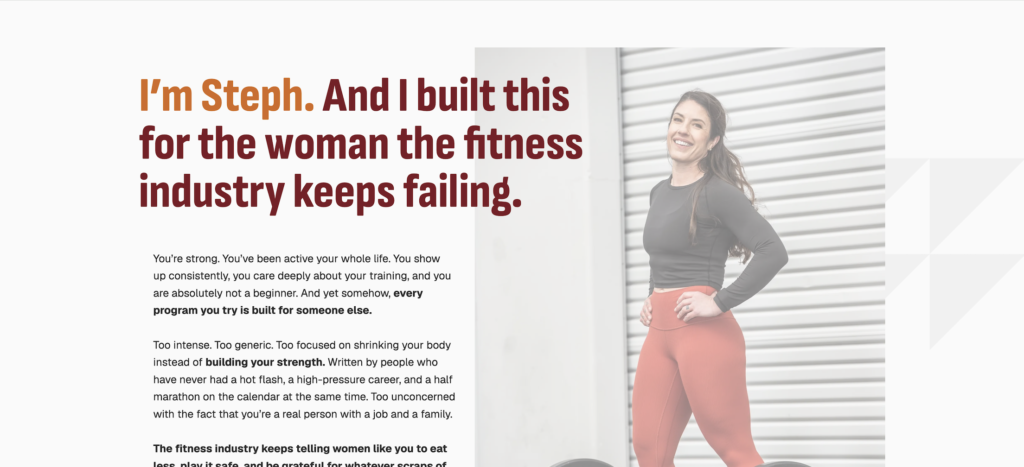
Steph Gaudreau’s About page shows the idea in a fitness setting. Her opening line says she built her program for the woman the fitness industry keeps failing, and the next paragraph describes that woman in detail.
2. An intro with your name, credentials, city, and a real photo
Your intro should run three or four sentences in first person: what your client is dealing with, who you are, and what it’s like to work with you. Use a real, current photo taken in your space or somewhere you’d actually be, not a stock image and not your LinkedIn headshot from 2016. Put your name, credentials, and city on this first screen, which also helps search engines connect the page to a real, local practitioner, and put a way to book witih you.
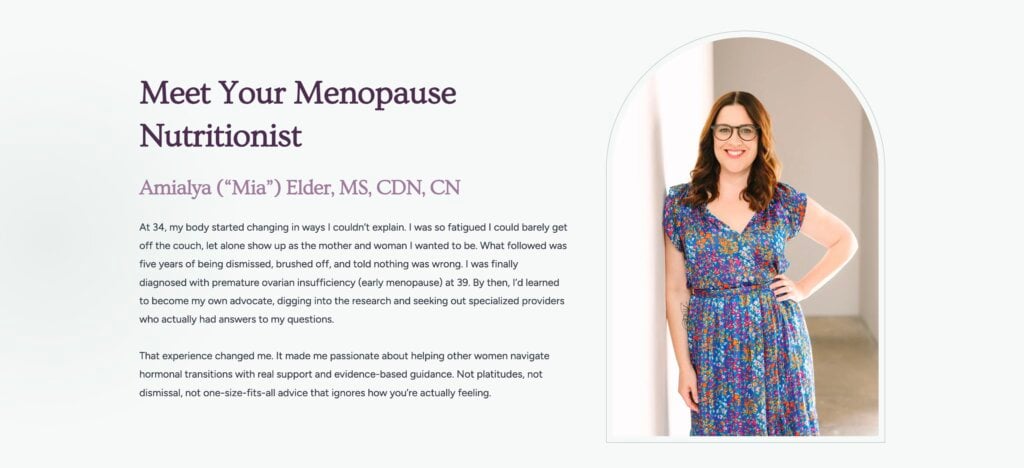
On Elderflower Nutrition’s page, Amialya Elder’s name and credentials sit directly under a headline that names her niche: “Meet Your Menopause Nutritionist.”
3. Who you help, and who you don’t
Say who you work with specifically. Not “I work with adults navigating life’s challenges,” but “I work with adults managing chronic illness, particularly people who are newly diagnosed and figuring out what their life looks like now.”
Then say who isn’t a fit and who you’d refer them to. This will help cut down on consult calls that go nowhere, and other practitioners send better referrals once they know exactly what you do. You can do this gently. Steph’s page tells her reader that her ideal client is “absolutely not a beginner.”
A dietitian whose practice is built around intuitive eating can say that very bluntly, and someone hunting for a strict 1,200-calorie meal plan will know she isn’t the match, which saves you both a discovery call.
4. What working with you is like
This section tells the reader what the first session looks like, or just your overall approach. Say how long the first session runs, whether it’s in person, on video, or both, and what you do with the first twenty minutes. If the full walkthrough lives on a new-client or FAQ page, write two sentences here and link to it.
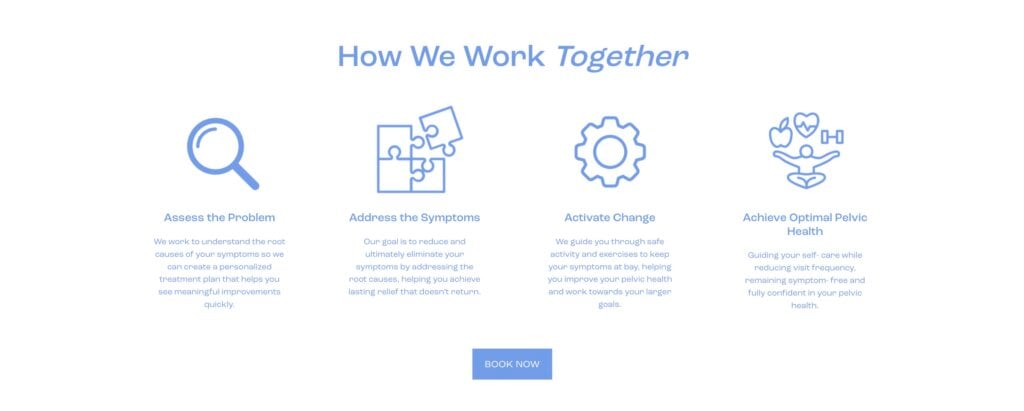
My client, ATL Pelvic Health, shows a four-step “How We Work Together” section that explains their client process.
Add one line of logistics, like “I’m out of network, here’s how superbills work” or “I offer a sliding scale,” with a link to your full fees page. Readers who find no hint of cost may assume the worst, which is not what we want.
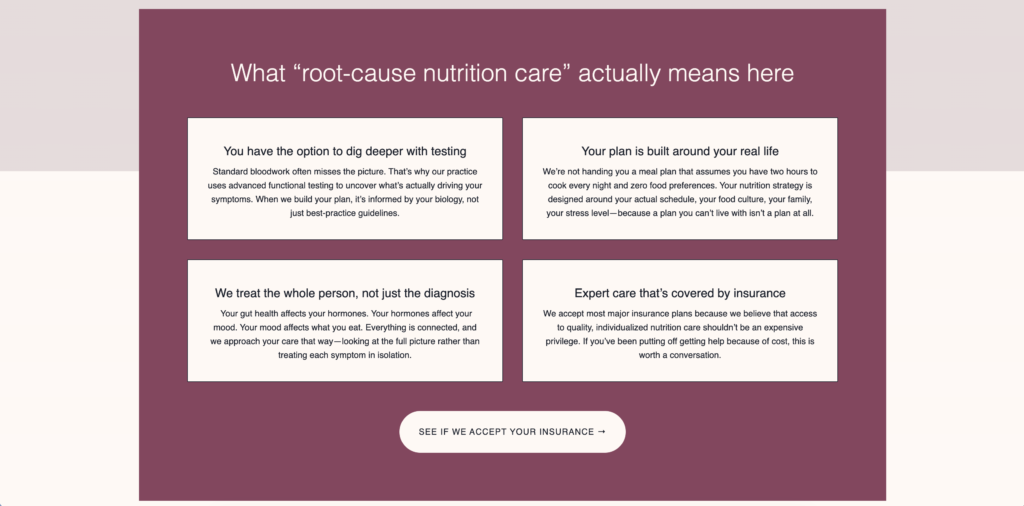
Another client of mine, Functional Nutrition Rx, puts insurance on its About page, where it names the number of plans it accepts and links to a page where you can check yours.
5. Your approach and values, shown in action
Your approach section is the part that separates you from your colleagues with the same credentials down the street. Before I write a word of an About page, I ask a client three questions:
- What is your approach to the work?
- What makes you different from someone with the same credentials down the street?
- What do you actually value as a practitioner?
The answers are almost always where the real About page lives. Then pick one or two values that change how you run a session and describe what that looks like. “I don’t assign worksheets in the first month, because I’d rather know you first” tells a reader far more than “client-centered” does. Steph does this by describing what she does when a client skips the jumping exercises in her training log: she asks why.
If you use a term like EMDR or somatic work, explain it in one sentence. If you want to welcome specific communities (LGBTQ+ affirming, neurodiversity-friendly, culturally responsive), say so on your About page. Functional Nutrition Rx spends a full paragraph naming the body sizes, gender identities, and abilities it welcomes, and closes with a promise that no client will be made to feel like too much.
6. Credentials section
Your credentials section should list your degree, license type, and state, plus any training or certifications that matter to the people you serve. Google, clients, and referral sources need to confirm quickly that you’re licensed, and your licensing board might have rules on how credentials must be displayed, so follow them.
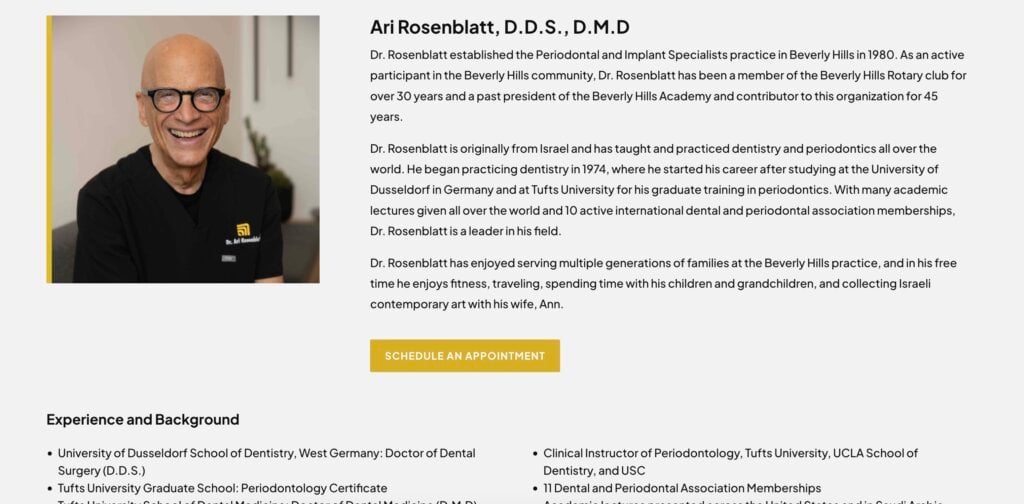
For most practices, short is better. Steph Gaudreau’s page lists 15 certifications and degrees in one bulleted block, which works because athletes shopping for a coach are checking qualifications. Periodontal and Implant Specialists of Beverly Hills gives each of its three doctors a background list of nine to twelve bullets, which fits a practice that takes referrals from dentists and physicians.
7. A few personal details tied to your work
Personal details belong in the middle or at the bottom of your About page, and 4-5 is plenty. Bonus points if you can tie your personal fun facts to your niche. For example, I mention how much I leg press because it’s impressive, but also because I work with fitness professionals.
Steph’s page does the same thing: competing in jiu-jitsu, lifting free weights, and twelve years of teaching high school science all connect to what she coaches. Elderflower Nutrition puts family, rescue dogs, and fruit-and-vegetable portraits under a “Beyond the credentials” heading, after the credentials. Pick facts that hint at how you show up in the room!
Even if you’re a group practice, you can still do this. ATL Pelvic Health gives every team member a “Facts About” list with a birthplace, a school, and hobbies, and that works because a new patient is choosing among seven physical therapists and this gives them a glimpse into their choices.
8. A short video (optional, but worth it)
A 60 to 90 second video of you saying hello lets someone hear your voice before they commit to a call. Talk about who you help and what the first session is like, and keep it loose enough that you sound like yourself.
9. A clear next step, twice
Every About page needs a way to book time with you or to inquire. Periodontal and Implant Specialists of Beverly Hills does this well: a “Schedule An Appointment” button in the header, another after each doctor’s bio, and one at the bottom. ATL Pelvic Health puts its “Book Now” button after its process section and repeats a button after each provider’s bio.
What should you leave off your About page?
There are a few things I would leave off your private practice About page:
- Long lists of modalities. EMDR, CBT, ACT, motivational interviewing, somatic approaches. If your reader doesn’t already know what these mean, the list creates distance. Pick the one or two most central to your work and explain them in plain language.
- Generic mission statements. “I believe in the power of the therapeutic relationship” and “I am passionate about helping clients live their best lives” appear on thousands of websites.
- A wall of text that opens with your education. I have yet to meet anyone who booked a consult because of paragraph one of a training history.
- Overly formal language. If your About page sounds like a grant proposal, it is probably working against you. Read it aloud, and rewrite anything you wouldn’t say that way to a client on a first call.
- Personal details as the centerpiece. Your love of hiking and your rescue dog are lovely. They belong in the middle or toward the bottom, not at the top of your professional introduction.
- Outcome promises you can’t back. Words like “cure,” “guaranteed,” or “heal your gut in 30 days” undercut trust with readers, and Google holds health content to a higher standard as “Your Money or Your Life” material.
List professional memberships briefly, since most clients don’t know what they mean. Press features fit on this page too, at least to start with. Once you have more than 10 to 15, give them their own press page.
How do you write about your specialty so the right person finds you?
Write your specialty in down to earth language, the way your ideal client describes what is happening to them. Clients don’t search the way you were trained to document; they search the way they think and feel.
| Clinical language | Lived language |
|---|---|
| Perinatal mood and anxiety disorders | Therapist for postpartum anxiety |
| Hormonal health concerns | Help for women in perimenopause |
| Disordered eating and body image disturbance | Support for a complicated relationship with food |
| Adjustment disorder following medical diagnosis | Figuring out life after a new diagnosis |
| Occupational stress and burnout intervention | Burned out and can’t keep going like this |
Clinical terms still have a place, we just don’t want it to be the majority of your copy. Someone with a diagnosis may search the exact term, so put the down to earth phrase in your headline and first paragraph and name the clinical term nearby. Provider bios on Functional Nutrition Rx name conditions like SIBO, IBD, and ARFID, which suits a reader looking for exactly that!
Take a menopause nutritionist, for example. She could write “I help women with hormonal health concerns.” Or she could write what Amialya (“Mia”) Elder wrote on her Elderflower Nutrition About page: that at 34 her body started changing in ways she couldn’t explain, that she spent five years being dismissed before a diagnosis of premature ovarian insufficiency at 39, and that she built her practice to offer what she wished she’d had. Same specialty, completely different impact.
Other client pages o fmine get specific in their own way. Steph Gaudreau names the exact collision her reader lives in: a hot flash, a high-pressure career, and a half marathon on the calendar at the same time. ATL Pelvic Health says no subject is taboo, and its founder’s bio says she wants patients back to the activities they love without “pain or peeing your pants.”
Specificity also helps Google and AI search tools read and retrieve your page. “I work with adults in their 30s and 40s who are managing burnout alongside a chronic health condition” is concrete enough to be found. “I help people live fuller lives” is not.
How should a private practice About page sound?
Your About page should sound like you, but it should also sound like the same person who wrote your Services page. When your About page is warm and your Services page reads like a legal document, visitors feel the friction even if they don’t know why.
Write to one person, the client you most enjoy working with, and use “you” as much as “I.” Your story matters, and readers also need to see how it connects to what they need.
I always tell clients that the read-aloud test still works the best. Read the page out loud and mark every spot that sounds stiff, every sentence you’d never say to a client, and every place it stops sounding like you. Rewrite those until they sound like you.
Sometimes brand voice changes with the size of the practice. The three group pages I looked at (Functional Nutrition Rx, ATL Pelvic Health, and Periodontal and Implant Specialists of Beverly Hills) write the practice introduction in “we” and each provider bio in third person. The solo pages (Elderflower Nutrition and Steph Gaudreau) speak in first person throughout.
How do you design an About page so people book?
Design your About page to be calm, consistent, and easy to scan:
- One palette. Pull your colors from your logo and photos, and alternate background colors to mark where one section ends and the next begins.
- Varied layout. Mix column layouts so the page doesn’t read as one long scroll.
- Phone first. Set body text at a size you can read on a phone without zooming. Check your analytics for your own mobile percentage, then design for it.
- Short paragraphs and real headings. Use your editor’s heading and list buttons instead of bold text styled to look like them, so someone can skim and a crawler can read the structure.
- Real photos. A natural photo where you look like yourself is often the first confirmation that you’re an actual person.
- A booking button in the header. It follows the reader down the whole site and covers the first-screen booking link on your About page. Periodontal and Implant Specialists of Beverly Hills carries “Schedule An Appointment” in its header.
- One social feed at most. Embed your main platform or just link to it, because each feed widget loads third-party scripts that can slow the page. Put a yearly reminder on your calendar to reread the page and update it when your services change.
Ask your designer or your SEO plugin to add Person schema to the page (structured data stating your name, credentials, and where else you appear online), and link your directory profiles, like Psychology Today, your licensing board lookup, and LinkedIn, so there is a clear trail from the page to your credentials. Use the same name, title, and credentials on every one of them. Elderflower Nutrition’s page links Amialya’s LinkedIn profile from the footer and lists her press features as logos, both of which give a reader and a search engine something to verify.
If you’d rather hand this off, I design About pages and full websites for private practice owners at Jess Creatives.
About page examples
I checked the About pages of five practices I built sites for, against the nine elements above. All five are my clients, so this is a check on my own work!
| Page | What it does well | What I would change |
|---|---|---|
| Functional Nutrition Rx (dietitian group practice, 15 providers) | Numbers up front (4,000+ clients served, 20 insurance plans accepted, 2,000+ telehealth patients); insurance named on the page; a paragraph welcoming specific groups | Open with the reader’s situation instead of the practice’s belief; describe the first appointment; move a booking button above the provider bios |
| Elderflower Nutrition (solo menopause nutritionist) | A specific lived-language story; name and credentials under the headline; press logos and a LinkedIn link; personal details placed after the credentials | A booking button near the top; a first-session description; a line on where she sees clients |
| Steph Gaudreau (strength and nutrition coach) | Opens by speaking to the reader; a personal story tied to her niche; tells beginners the program isn’t for them without saying so | Group or shorten the 15-item credentials list; add what a new client’s first weeks look like; link to her programs higher on the page |
| ATL Pelvic Health (7 pelvic floor physical therapists) | A four-step process section; a booking button after each provider bio; a testimonial and a “Facts About” list for each provider | Open with the patient’s situation instead of the philosophy; describe what happens at a first visit |
| Periodontal and Implant Specialists of Beverly Hills (3 periodontists) | A header booking button plus one after each doctor; specific figures; speaks to patients and to referring dentists | Move the line for anxious patients (“Dental challenges don’t have to be traumatic”) from the bottom to the top; describe what a first consultation involves |
Check your own page against the same list. Open it on your phone and count how many of the nine elements you can find!
FAQ about private practice About pages
Should my About page be different from my Psychology Today or directory profile?
Yes. Your directory profile is written for a platform with its own formatting rules, character limits, and audience expectations. Your About page lives on your own website, so you control the length, tone, structure, and search strategy. Use it to go deeper: more of your voice, more specificity about who you help, and more context than any directory allows. Think of your directory profile as the billboard and your About page as the conversation.
Do I need a separate About page if I’m a solo practitioner?
Yes! When you are the practice, your About page introduces you as a person and your business at the same time. There is no team page, no company history, and no other clinicians to share the trust-building, so everything a potential client needs to feel confident reaching out rests on that one page.
Should I mention my fees or insurance on my About page?
Briefly. Give one line of logistics, such as your session format and whether you’re out of network or offer a sliding scale, and link to your full Fees or FAQ page. If you bill insurance, say so on the page; Functional Nutrition Rx names the number of plans it accepts and links to a page where you can check yours. If your fee structure is part of your practice identity, like a sliding-scale-only practice, say that plainly. If insurance doesn’t apply to your work, as with a personal trainer, skip it and link to your program pricing.
What’s the difference between an About page and a bio?
A bio is a third-person summary of your credentials and background, typically written for directories, conference programs, or guest posts. An About page is a first-person introduction written directly to your potential client. A bio answers “who is this person?” An About page answers “is this the right person for me?” They serve different purposes and should be written differently, even if they pull from the same facts.
How do I write a bio for a therapist?
Write it in third person, lead with who you help rather than where you trained, and put your license and location near the top. Keep a short version of a few sentences for directories and speaker intros, and a longer one for your own site’s team or press pages. Then use the same facts, in your own voice, for your About page.
Can I have more than one About page if I serve different populations?
You can, but it takes careful thought. If you genuinely serve two very different populations, like adolescents and adults, or individual therapy clients and corporate wellness clients, separate pages let you speak directly to each group. The risk is looking unfocused and diluting your authority. A cleaner approach for most solo practitioners is one strong About page that names your primary populations explicitly, with links to population-specific service pages where each group can find more detail.
What should a group practice About page include?
A group practice About page should open with who the practice serves and how a new client gets matched with a provider, then give each provider a short bio in the same order every time, with a booking button after each one. All three group pages I checked keep their provider bios in a consistent order, and ATL Pelvic Health and Periodontal and Implant Specialists of Beverly Hills put a booking button after each one. Lead each bio with what that provider treats, as Functional Nutrition Rx does, so a reader can find the right person without reading all fifteen.
How long should an About page be?
Long enough to cover the nine elements, and short enough that a skimmer finds their answer. The two solo pages I checked, Elderflower Nutrition and Steph Gaudreau’s, carry reading-time estimates of two and three minutes in their page metadata. Functional Nutrition Rx and Periodontal and Implant Specialists of Beverly Hills carry 11 and 23, because each provider needs a bio. Cut any section that repeats a point without adding a fact or an example.
