
My Website Doesn’t Show Up in Google Search (How to Fix It!)
Written by Jessica Freeman, Web Designer and SEO Strategist since 2011 • Post Last Updated October 2026
If your private practice website isn’t showing up on Google, it’s almost always one of three things: Google hasn’t indexed your site yet, something on your site is blocking search engines, or your site is indexed but doesn’t have enough optimized content to rank. It’s frustrating — but it’s fixable, and you can diagnose most of it yourself in the next ten minutes.
After auditing hundreds of therapist, dietitian, and practitioner websites since 2011, I can tell you the most common culprit isn’t technical at all: roughly 75% of the practice owners who come to me have never set up Google Search Console, and most either have no SEO plugin installed or have one installed with none of the fields filled in. Let’s walk through how to figure out which problem you have — and how to fix it.
How Do I Check If My Website Is Indexed by Google?
Type site:yourwebsite.com into Google (using your actual domain). If your pages appear in the results, your site is indexed. If nothing comes up, Google doesn’t have your site in its index yet — and no amount of keyword work will matter until that’s fixed.
This is always the first diagnostic step, because it tells you which problem you’re solving. If your pages show up in a site: search but you can’t find yourself when you search “dietitian in [your city],” you don’t have an indexing problem — you have a ranking problem, which is a different fix (more on that below). If nothing shows up at all, keep reading, because the next two sections are for you.
[Screenshot suggestion: a site: search result for one of your client sites, with the practice name blurred if needed]
Why Hasn’t Google Indexed My Website Yet?
Google doesn’t automatically know about your website the moment it goes live — and if you’ve never told Google your site exists, it may take a long time to find you on its own. The fix is Google Search Console: a free tool from Google that lets you submit your site, request indexing, and see exactly which pages Google has (and hasn’t) picked up.
In my experience, this is where most private practice websites fall down. About 75% of the practice owners I audit have never set up Search Console at all. Their site isn’t broken — Google just hasn’t been formally introduced to it.
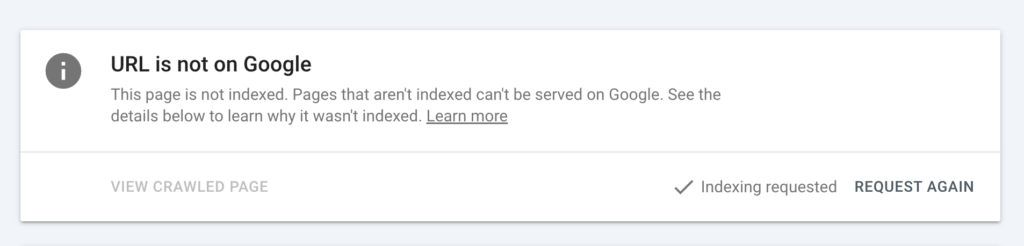
The fix: Set up Google Search Console, verify your site, and submit your sitemap. For individual pages, paste the URL into the URL Inspection tool and click “Request Indexing.” It doesn’t guarantee instant results, but it dramatically speeds things up.
Indexing problems aren’t always all-or-nothing, either. A dietitian client of mine had a website that had been live for about a year — her older pages and posts were indexed just fine, but her most recently written posts weren’t showing up at all. We didn’t have to overhaul anything: we simply requested indexing on the missing posts in Search Console and asked Google to recrawl the site. Google indexed them, and then resumed picking up her new posts normally on its own. Sometimes Google just needs a nudge.
How Long Does It Take Google to Index a New Website?
Indexing a new website typically takes anywhere from a few days to a few weeks once you’ve submitted it through Google Search Console. But here’s the distinction most people miss: indexing is not the same as ranking.
Indexing means Google knows your pages exist. Ranking means Google shows your pages to people searching. Based on my client launches, if your domain has some history and an active blog, expect about 2–3 months before you start seeing meaningful ranking movement and traffic. Brand-new domains with no content history take longer. So if you launched your site three weeks ago and you’re not on page one yet — that’s not a problem, that’s just the timeline. SEO is a compounding game, not an overnight one.
Is Your Website Accidentally Blocking Google?
Sometimes a website doesn’t show up on Google because it’s literally telling Google to stay away. This happens more often than you’d think — usually a noindex tag left over from when the site was being built, or a checked box buried in your website settings.
The fix: If you’re on WordPress, go to Settings > Reading and make sure “Discourage search engines from indexing this site” is unchecked. (Web designers check this box on purpose while a site is under construction — and it sometimes gets forgotten at launch.) You should also check that your robots.txt file isn’t blocking pages you want indexed. If you set up Search Console in the last step, it will flag pages excluded by noindex in the Pages report, so you don’t have to dig through code to find them.
Is Your Content Optimized for What Clients Actually Search?
Being indexed gets you into Google’s library, but ranking requires your content to match the words your potential clients actually type. This is where credentialed practitioners often get in their own way: you write the way you were trained, and your clients search the way they talk.
For example, if you’re a dietitian specializing in maternal health, “maternal nutrition” may feel like the obvious keyword — but the moms you want to reach are searching “nutrition help for new moms” or “what to eat while breastfeeding.” Targeting those longer, more specific phrases (called long-tail keywords) is less competitive and matches real search behavior. Postpartum dietitian in Atlanta” will get you further than “nutrition services.
Two practical pieces here:
Use an SEO plugin and actually fill it in. Installing Yoast or Rank Math does nothing by itself. Among the practice owners I audit, having no SEO plugin (or one with empty fields) is right behind the missing Search Console as the most common issue. Every page and post needs its SEO title, meta description, and focus keyword filled in.
Link your pages together. Internal links — linking your blog posts to your services page, related posts to each other — help visitors navigate and tell Google which pages matter most on your site.
Why Is My Website Indexed But Still Not Ranking?
If your pages show up in a site: search but you’re nowhere to be found for the searches that matter, the problem is usually content: either there isn’t enough of it, or what’s there isn’t built around what people search. A five-page website gives Google very little to work with — and very few reasons to consider you an authority on anything.
Here’s what that looks like in practice. The Sleepyhead Coach, a pediatric sleep consulting practice I redesigned, came to me with a site that was technically live and indexed — but ranking for only about 40 keywords, with next to zero organic traffic. The expertise was real; the website just wasn’t structured around what parents actually search. We reorganized the services by age group (because parents search “my 4-month-old won’t sleep,” not “1:1 coaching package”), expanded thin service descriptions into pages that answered real questions, and added a blog to target the questions parents were already Googling. After the relaunch, the site grew to rank for over 2,000 keywords — a 50x increase in search visibility — and the owner hit her average monthly sales within the first week of one month.
You don’t need to blog weekly forever. But consistent, search-informed content — added at whatever pace is sustainable for your practice — is what moves a site from “indexed” to “found.”
Track Your Progress in Google Search Console
Once your fixes are in place, Search Console becomes your scoreboard. The Pages report shows what’s indexed (and why excluded pages were skipped), and the Performance report shows which searches are actually bringing people to your site. Check it monthly — not obsessively — and remember the 2–3 month timeline before judging your results.
FAQ: Private Practice Websites and Google Search
-
How do I check if my website is on Google?
Type
site:yourwebsite.cominto Google. If your pages appear, you’re indexed. If nothing appears, submit your site through Google Search Console. -
How long does it take for a new website to show up on Google?
Indexing usually takes a few days to a few weeks after submitting through Google Search Console. Seeing actual ranking results and traffic typically takes 2–3 months for domains with some history and a blog — longer for brand-new sites.
-
Why is my website on Google but not on the first page?
Being indexed and ranking well are two different things. Sites that are indexed but not ranking usually need more content optimized around the specific phrases clients search — not just more pages for the sake of volume.
-
Do I need Google Search Console for my private practice website?
Yes, it’s free, and it’s the only way to see exactly which of your pages Google has indexed, request indexing for new ones, and find errors blocking your site. About 75% of the practice owners I audit have never set it up.
-
Do I need an SEO plugin like Yoast or Rank Math?
If you’re on WordPress, yes, but installing it isn’t enough. You need to fill in the SEO title, meta description, and focus keyword for every page and post, or the plugin does essentially nothing.
-
How many blog posts do I need to rank on Google?
There’s no magic number, but a handful of pages won’t establish authority. My client, The Sleepyhead Coach, went from 40 to 2,000+ ranking keywords by restructuring and expanding content around real search phrases — volume helps, but only when it’s targeted.
If you’ve run through these steps and you’re still stuck — or you’d rather hand this off to someone who does it every day — I offer SEO consulting and audits specifically for private practice owners. Let’s figure out what’s holding your site back and get you in front of the clients searching for exactly what you do.
